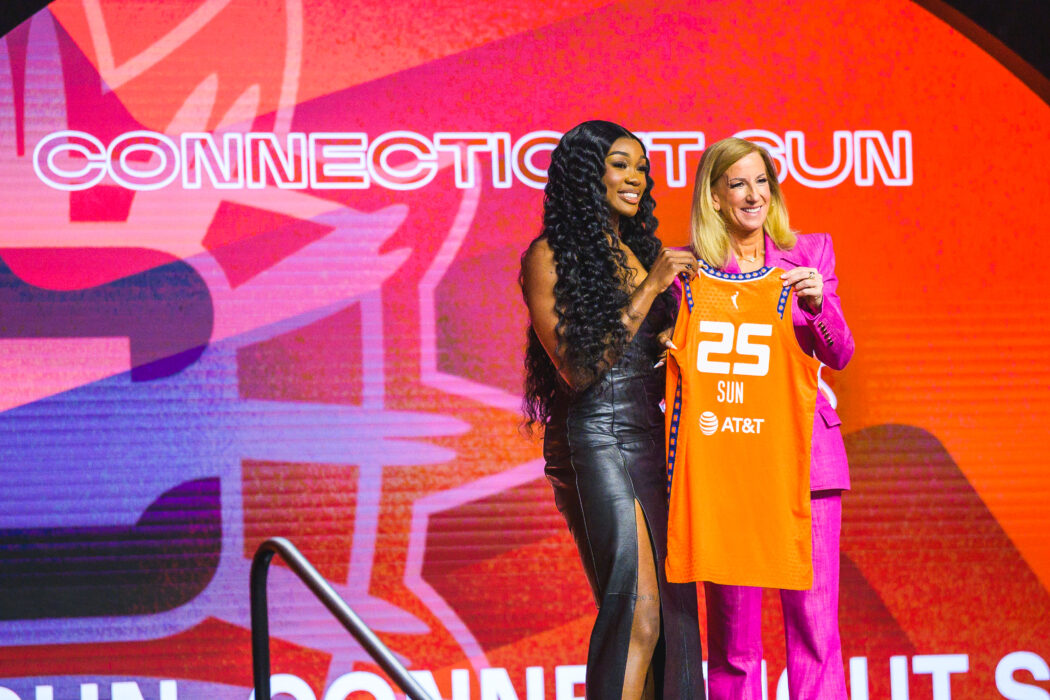
When the initial report came out about a possible deal to relocate the Connecticut Sun to Boston, it appeared to make all the sense in the world. After all, the Sun have attempted to, in recent years, market itself as New England’s team as opposed to simply the Nutmeg State’s.
If one wants to be New England’s team, one has to build a fanbase in the region’s flagship city – Boston.
The Sun have even played one game a year at Boston’s TD Garden. The WNBA has been practically teasing Boston for the last several years that the league’s rapid growth would eventually lead to a franchise – likely the Sun – being placed there.
But dark clouds have been placed recently over Boston’s hopes of landing a team because of how Cathy Engelbert appears to be handling things.
It appears that initial statement that The Boston Globe and The Athletic shortly after the initial Globe report was actually not public relations posturing. Steve Pagliuca’s $325 million bid to purchase the team from the Mohegan Tribe and relocate it to Boston appears to have faced a massive headwind thanks to Engelbert.
Engelbert, as it was later revealed by Annie Costabile at Front Office Sports, never presented the bid for a vote by the WNBA’s Board of Governors. In addition, a rival bid from former Milwaukee Bucks minority owner Marc Lasry which was set to keep the team in Connecticut but relocate its home base to Hartford, also was not presented to the Board of Governors.
It has since been reported by Sports Business Journal that Houston-based Tillman Fertitta could be the WNBA’s preferred buyer from the team. Perhaps, this is what Engelbert was talking about when she mentioned at the joint expansion announcement for Cleveland, Detroit and Philadelphia that the W had a close eye on Houston.
The premise for Pagliuca and Lasry’s bids not even being presented for a vote by the Board of Governors is that Pagliuca and Lasry never applied for an expansion franchise and Engelbert is prioritizing owners who did so.
Pagliuca’s bid reportedly included a plan to invest $100 million in a practice facility and a plan to play home games in other New England cities – ala what the Toronto Tempo have planned for the entire country of Canada.
One can understand Engelbert’s thinking in most cases – not in Boston’s.
Why would any owner who desired a Boston team apply for an expansion franchise when there was already an existing franchise only a hop, skip and jump away from Beantown – especially when that franchise has attempted to build a fanbase throughout New England (including Boston).
This was especially the case once the Mohegan Tribe decided to put a “For Sale” sign in front of the Sun. The move that would make the most sense was one to Boston. In fact, the presence of the Connecticut Sun was probably why Boston’s preferred route to a franchise was via relocation.
The Mohegan Tribe, sadly, simply did not have the money to be able to compete in today’s big budget WNBA. It is an unfortunate byproduct of the W’s growth that the lone Native American ownership group within its ranks has been priced out by the likes of Clara Wu Tsai and her husband Joe (New York Liberty), Mark Davis (Las Vegas Aces) and Mat Ishbia (Phoenix Mercury).
Why did Engelbert never present the Pagliuca bid to the Board of Governors? Because she knew the Board of Governors would laugh in her face and approve the deal anyway.
The not-so-dirty little secret about many sports owners is many of them do not know the meat and potatoes of the sports that their teams play in. That is why smart owners like Tsai, Davis and Ishbia do not meddle in the daily operations of their teams on the sports side. They stick to the business side and simply sign the checks.
But if it is one thing they do know – it is money – and there is a lot of it coming the WNBA’s way as has been well-documented.
The Connecticut Sun play in the WNBA’s smallest city – Uncasville, Connecticut at the Mohegan Sun Resort & Casino. If the Sun are worth $325 million and the market (Pagliuca) has dictated that the team is at least worth that, then teams like the Liberty and Golden State Valkyries could be worth more than their current valuations of $450 million and $500 million, respectively. The Lasry bid, reportedly, is also north of $300 million.
If the Sun – which are a rebuilding franchise – are worth $325 million then the Indiana Fever, which was recently valued at $330 million, are surely worth more than that in its Caitlin Clark era.
How much could the WNBA be worth as a whole if one owner sees the Sun as being worth $325 million? That is the key calculus these owners will make with any bid – whether it moves the team to another state or if it keeps the team in Connecticut.
The biggest mistake Engelbert could be making with the handling of this Sun sale is potentially ticking off an entire city’s fanbase.
It has been suggested that the WNBA’s plan could be to hold off on Boston claiming a franchise until 2033. Boston has been teased (ala Toronto via the annual Canada Game) the past few seasons with one game a year at the Celtics’ home court of TD Garden.
Engelbert is playing with (no pun intended) fire with these Connecticut developments. She is running the risk of making an entire city so angry that it may sour on the WNBA now and in the future. And Boston, as rich and as passionate a basketball market as it is, is not a market a smart executive would want to make apathetic towards your league.
This could especially be the case if another city, like Houston, wins the Connecticut Sun sweepstakes. Would that be the way Engelbert would want to see the return of the Houston Comets? Engulfed in controversy because of how another city was teased?
Even in this period of robust growth for the WNBA, we see instances of the W reverting to its old ways and continuously fumbling the bag. This move to Boston ought to be a clear-path layup for the WNBA, but because of the league’s recent history, there is always that risk of it blowing the bunny.