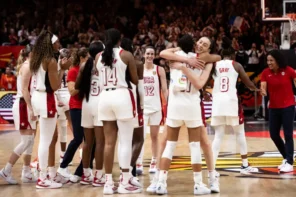

We are only days away from the tip-off of this year’s FIBA Women’s World Cup. The last time a FIBA 5×5 competition concluded, it was in Australia with Team USA securing a victory in the gold medal game against China.
The host Australian Opals defeated Canada in the bronze medal matchup to earn a spot on the podium along with China and Team USA.
USA Basketball has already claimed one gold medal in a FIBA competition. That FIBA competition was the 3×3 World Cup in Poland when the all-SEC quartet of LSU’s Mikaylah Williams and MiLaysia Fulwiley, South Carolina’s Joyce Edwards and Oklahoma’s Sahara Williams prevailed in a nail-biter over Australia to depart Warsaw with gold medals.
Team USA looks to make it 2-for-2 in FIBA competitions this year. Coach Kara Lawson’s squad did take a massive hit a few days prior to the competition when it was revealed that A’ja Wilson – MVP from the 2022 competition – would not compete in Germany because of health issues. Kelsey Plum also would miss this year’s competition – as well as the remainder of the WNBA season which will resume once the World Cup concludes.
While Wilson and Plum leave massive shoes to fill, if any organization can replace them it is USA Basketball. Lawson decided that two names that already wear red, white and blue uniforms on a regular basis would serve in the steads of Wilson and Plum.
Those two would be Sonia Citron and Kiki Iriafen of the playoff-bound Washington Mystics.
Those two join a stacked roster that includes a backcourt of Paige Bueckers, Caitlin Clark (MVP of the qualifiers), Kahleah Copper, Jackie Young, Rhyne Howard and Chelsea Gray. It also features a frontcourt of Breanna Stewart, Napheesa Collier, Aliyah Boston and Angel Reese.
Even with these late scratches, one still has to consider Team USA the favorite until another team knocks it off its perch. But, as we remember, France was dangerously close to doing so on its home soil at the Paris 2024 Olympics.
We have looked at what the Stars and Stripes will resemble heading into competition in Berlin….but what about the rest of the field? We at Beyond The W continue our FIBA World Cup preview by looking at the assemblings in the group the defending gold medal winners will be in – Group D.

Team USA may have departed from the 2022 FIBA World Cup in Australia with gold medals draped around their necks. Two nations, of course, joined the Stars and Stripes on the medal stand four years ago. China was one of those nations.
China earned its berth in this year’s FIBA Women’s World Cup initially via going 4-1 in the FIBA Women’s Asia Cup. It was one of the top six teams from that tournament – finishing only behind Australia and Japan last year.
China was actually one of the host nations of a FIBA qualifying tournament that also featured Belgium, Mali, Czech Republic, Brazil and South Sudan. Since China was one of the top four teams in that qualifier, it punched its ticket to Germany.
WNBA fans may be most familiar with the name Han Xu (New York Liberty) who finished with 22 points and eight rebounds in that final qualifying contest against Brazil that China won by a final score of 83-71. Yang Shuyu also sent out seven assists in that contest.
Unfortunately for China, it will miss Li Yueru as she is a late scratch due to a passport issue.
When looking at Italy being ranked the 14th best team on the planet per FIBA, it would make sense that it would be part of the 16-team field for this year’s FIBA World Cup. Italy is actually snapping a long streak of not being part of the FIBA party – the last time Italy qualified for a FIBA World Cup was in 1994.
In fact, Italy has not even qualified for an Olympics since Atlanta 1996.
Italy managed to qualify for this year’s FIBA World Cup after being part of a qualifying tournament that took place in Puerto Rico. Italy finished second – only behind the United States – at 4-1.
That lone defeat was, of course, to Team USA. Two names that are likely familiar to fans of the W are Lorela Cubaj and Cecilia Zandalasini. Zandalasini has blossomed into a featured name with the Golden State Valkyries.
Italy earned a signature win over Spain in those qualifiers. Zandalasini scored 22 points in that 68-56 win over España. Cubaj also grabbed four rebounds.
Czechia is ranked 17th which, on paper, would be a sign that an upcoming FIBA Women’s World Cup would not be in the cards. But that is why the games are played and exactly why these qualifying tournaments exist.
It managed to find its way to the FIBA Women’s World Cup after earning a fourth-place finish in Wuhan. It was one of three that concluded its time at the qualifiers with a 2-3 record with the other two being Mali and Brazil.
Czechia was on the receiving end of defeats to China and Belgium to close out the FIBA qualifier in China but did manage to score one of its two victories at the expense of Brazil. That made the difference between either Czechia or Brazil claiming one of those qualifying spots once the schedule in Wuhan was finished.
Fans in the states are likely familiar with the name Eliška Joklová (Minnesota Lynx). She was instrumental in that 84-65 victory in the qualifiers with seven rebounds and six assists.

Whenever one sees Australia as part of an international tournament field such as the FIBA World Cup, one automatically must believe that the Opals are a threat to win the whole tournament.
The hosts of the last FIBA World Cup, Australia still finished on the medal podium with the United States and China after its victory over Canada – a blowout 95-65 decision.
As the winner of last year’s FIBA Women’s Asia Cup, Australia did not have to worry about a qualifying tournament to earn a berth to the World Cup. Coach Sandy Brondello’s Opals prevailed in an 88-79 victory at the Shenzhen Arena to claim one of the berths to this year’s FIBA World Cup.
A big difference in that contest was Australia outscoring Japan by a margin of 29-20 in the first quarter. Alex Fowler led all Opals bucket-getters in that contest with 15. The number of WNBA talents on Australia reads like a who’s who – including Chloe Bibby, Isobel Borlase, Ezi Magbegor, Jade Melbourne, Alanna Smith (who was not selected for Australia’s World Cup in 2022) and Stephanie Talbot.
Even though Australia’s spot in this year’s FIBA World Cup was already secure, one would not know it by the 5-0 performance that the Opals put together at the FIBA qualifier in Turkey. One of the first contests of this year’s FIBA Women’s World Cup will be on Friday when third-ranked Australia matches up against Puerto Rico.
Sami Whitcomb (injury) is one name that Australia will sorely miss.

Coach Mike Thibault’s Belgian Cats are another assembling that earned a berth to the 2026 FIBA World Cup sans having to compete in a qualifier. This was on account of Belgium winning the EuroBasket Women Tournament back in June of last year.
Four nations hosted that tournament – Czechia, Germany, Italy and Greece.
Belgium was originally part of Group C for that tournament and finished 3-0. The Belgian Cats earned a blowout victory over Germany in the first round then were in nail-biters against Italy and Spain in the semifinals and finals, respectively, to claim the EuroBasket Women Tournament and a berth to this year’s World Cup.
An evenly matched contest saw Spain outscore Belgium by a margin of 19-18 in the first quarter before Belgium outscored Spain by small margins in the ensuing three frames. Julie Allemand tallied 19 points while Emma Meesseman, who was named the tournament’s MVP, finished with 11 rebounds and seven assists.
Belgium is another team with plenty of names familiar to many a WNBA fan – including Allemand, Meesseman, Julie Vanloo and Kyara Linskens.
For a long time since Puerto Rico established a women’s basketball team, it did not qualify for FIBA World Cups. This changed in 2018 when it was part of that year’s 16-team field. Puerto Rico’s fortunes continued to trend in a positive direction when it won two games in the 2022 FIBA World Cup in Australia and earned a berth to the quarterfinals.
One would have to believe Puerto Rico is in search of even bigger and better things at this year’s tournament in Berlin. Puerto Rico earned its berth to this year’s international tournament following the qualifier that took place on Puerto Rican soil.
Considering that Puerto Rico was in a field with Team USA, Italy and Spain, Puerto Rico’s strategy had to be that since the top four finishers advance (and Team USA already earned a World Cup berth following its Women’s AmeriCup victory), all it had to do was outdo Senegal and New Zealand and it was in.
Puerto Rico’s time at its qualifier began with a rocky start by virtue of defeats to Team USA, Italy and Spain. A 56-47 win over Senegal and a 77-61 victory at the expense of New Zealand ensured Puerto Rico would be bound for Berlin. Puerto Rico’s efforts in that matchup with New Zealand were spearheaded by 18 points of Pamela Rosado, nine rebounds via Imani McGee-Stafford and four assists from Arella Guirantes.
Puerto Rico will be involved in one of the first contests of this year’s FIBA Women’s World Cup on Friday as it faces off against Australia.
Türkiye is the 16th-ranked FIBA per the latest rankings which were revealed in April. At the 2014 tournament, Turkey finished barely off the medal stand (USA – gold, Spain – silver, Australia – bronze) prior to a 10th place finish in 2018.
It did not qualify for the most recent FIBA Women’s World Cup in 2022 but did so this time because of its performance at the FIBA qualifier held on Turkish soil.
Türkiye did not let its home fans down as the first contest of said qualifier was a 71-69 victory over Canada. The team jumped out to an excellent start against Canada by outscoring it in the first quarter by a margin of 21-8. Canada staged a furious comeback in the second half but it came up just short.
A close loss to Argentina was followed by a 75-67 victory over Japan. It was spearheaded by Kennedy Burke getting one rebound shy of a double-double as she finished with 25 points and nine boards.
Türkiye will be one of the full field of 16 teams set to take to the court on the first day of play. Its first opponent of the group stage will be Belgium on Friday.
To many a Team USA aficionado, France needs no introduction. After all, this was the team that came within an eyelash of snapping the Stars and Stripes’ gold medal streak at the Paris 2024 Olympics before Copper saved the red, white and blue by being “that …”
From the outside looking in, it may be a bit of a shock to see that France went from a silver medal in Paris to finishing off the podium at the EuroBasket Women tournament last year (won by Belgium). This meant that Les Bleues – currently the second-ranked team in the world – would need a qualifier to earn its tip to Berlin.
One thing that France had going for it was the tournament qualifier being held on French soil – and the team responded by going 5-0 in that field.
France won every game of that qualifier by at least 17 points. It would be Nigeria’s D’Tigress that would give Les Bleues toughest test but it held on to a 93-86 triumph over Nigeria.
Janelle Salaün, who has become a star with the Valkyries, led the way with 19 points in that contest. France also benefitted from seven rebounds courtesy of Marième Badiane and six assists from Pauline Astier.
France is second-ranked because it presents one of the most stacked teams of any assembling in this tournament. It includes Valeriane Ayayi, Carla Leite, Leïla Lacan, Dominique Malonga and, of course, Marine Johannès and Gabby Williams.
Les Bleues open this year’s tournament opposite Hungary.
Speaking of D’Tigress….
The last time Nigeria took part in a FIBA Women’s World Cup was in 2018 in Spain. D’Tigress made the quarterfinals that year. In 2022, Nigeria had to withdraw from the 2022 Women’s World Cup because of all the political volatility that was unfolding in the nation at the time. FIBA invited Mali to serve in the stead of Nigeria.
Nigeria made a triumphant return to international competition at the 2025 Women’s Afrobasket tournament. Winning said tournament to punch its ticket to this year’s Women’s World Cup had to be so cathartic for D’Tigress.
After winning both of its group stage, it along with Mali, Uganda and host nation Côte d’Ivoire, earned byes to the semifinals. D’Tigress dispatched Cameroon in the semifinals, then earned a 13-point victory over Senegal to set up its big win over Mali for the right to ball out in Berlin.
Ezinne Kalu led the D’Tigress attack with a 20-point performance. Nigeria’s efforts on the boards were led by Murjantu Musa’s 12 rebounds. Promise Amukamara concluded the game with 11 assists.
Nigeria did not have to worry about qualifiers because of its Afrobasket victory but did go 2-3 in said qualifier in France. D’Tigress drew South Korea this Friday for its opening matchup of the group stage.
South Korea has qualified for every FIBA Women’s World Cup ever since 1959 when it finished in eighth place. It had runner-up showings in 1967 and 1979 – the latter of which was staged on Korean soil.
Its highest finish at a recent FIBA Women’s World Cup took place in 2002 in China when South Korea barely finished off the medal stand for a fourth-place finish behind USA (gold), Russia (silver) and Australia (bronze).
South Korea would need a qualifier to earn its spot in this year’s FIBA Women’s World Cup. Its qualifier in France got out to a rocky start with a double-digit loss to Germany. South Korea then reeled off three consecutive victories over Nigeria, Colombia and The Philippines.
Kang Lee-seul paved the way to victory for South Korea with a 24-point effort and the South Korea cause was also aided by nine rebounds each courtesy of Park Ji-hyun and Park Ji-su. Fifteenth-ranked South Korea’s first game of this year’s FIBA Women’s World Cup will be on Friday vs. Nigeria.
The most recent occasion of Hungary qualifying for a FIBA Women’s World Cup was in 1998 when the tournament was still referred to as the FIBA World Championship for Women. At that 1998 tournament, which also emanated from Germany, Hungary finished 10th out of 16 teams.
Hungary is hoping for a better showing than its version from the late 1990s. It was another of the 11 teams that earned a berth to the tournament by virtue of its performance in a FIBA qualifier.
Hungary took part in the qualifier that emanated from Turkey – and more than held its own. Its only losses were against Canada and an Australian Opals team that was undefeated despite already qualifying for the FIBA Women’s World Cup since it won the 2025 Women’s Asia Cup.
A signature win of that tournament occurred on March 17 when Hungary defeated Turkey in Istanbul by a final score of 89-74. Hungary’s key player is a name very familiar to WNBA fans – Dorka Juhász of the Minnesota Lynx. She was one rebound shy of a double-double as she grabbed nine in addition to the 24 points she scored against Turkey.
Hungary opens this year’s FIBA World Cup on Friday against France.
As of now, Spain sits as the sixth-ranked team in the world. From 1994 to 2018 – the latter of which was a tournament that Spain hosted – España qualified for every FIBA Women’s World Cup. That streak was snapped with the 2022 World Cup in Australia but Spain has made a triumphant return.
Spain also notably had a disappointing finish at the Paris 2024 Olympics finishing fifth and off the medal stand. It earned a berth to this year’s FIBA Women’s World Cup after FIBA qualifier in Puerto Rico where it finished behind Team USA and Italy.
Spain set an emphatic tone for that qualifier after a 99-50 victory over New Zealand. It then followed it up with an 84-51 victory to dispatch Senegal. A 91-52 decision over host Puerto Rico would be Spain’s final victory of the qualifier.
In that contest, Spain was spearheaded by a 21-point performance courtesy of Megan DiLeo. Iyana Martín aided España’s efforts with seven rebounds as did Mariona Ortiz with six assists.
Spain’s roster also includes names such as Awa Fam, Alba Torrens, Maria Conde, Raquel Carrera and Maite Cazorla. Spain opens this year’s tournament against Germany.
While Germany may be this year’s FIBA Women’s World Cup hosts, Japan will have its turn at the FIBA microphone in four years at the next tournament.
When the 2010 World Cup took place – hosed by Czechia that year – it was the first time that Japan had qualified for said tournament since 1979. Japan earned its way into this year’s World Cup by virtue of its showing at one of the FIBA qualifiers.
Japan was on the bubble for qualification as the final berth from that Turkey tournament was up for grabs between it and Canada. Japan earned a close victory over Canada with the final score being 66-62 prior to defeating Argentina in a rout with the final score being 83-39.
Mai Yamamoto concluded the contest with Canada with a team-high 16 points – and also sent out seven assists in the rout of Argentina. Also helping Japan’s cause against Canada was Yuki Miyazawa’s six rebounds plus five assists via Kokoro Tanaka.
Its roster also features names such as Stephanie Mawuli, Ramu Tokashiki and Rui Machida. Japan’s first matchup will be against Mali.
As this year’s host nation for the FIBA Women’s World Cup, the home court advantage will certainly be with Germany throughout the tournament.
As the host nation for this year’s FIBA Women’s World Cup, Germany was automatically qualified. It will have a tough task when play opens up on Friday in a group stage get-together with Spain.
Deutschland finished seventh at the Olympics two years ago in Paris. Prior to this year, Germany had only made one previous appearance in a FIBA World Cup. That was in 1998 which it also hosted. That year, Germany finished compiled three wins and five losses en route to an 11th place finish.
Even with Germany as an automatic qualifier, it still did put forth an impressive performance at the FIBA qualifier in France. Germany’s only defeat in that tournament was to the French. Among its impressive victories was an 81-73 decision against Nigeria. Deutschland only led D’Tigress by a margin of 54-52 heading into the fourth quarter but was able to put enough distance between eleventh-ranked Germany and Nigeria to hold D’Tigress off.
Leonie Fiebich scored 15 points in that victory. Nyara Sabally hauled in eight rebounds. Fiebich as well as Alexis Peterson each dished out eight assists. Its roster also includes familiar names such as Frieda Bühner and Luisa Geiselsöder.
Just as there are injury concerns surrounding Team USA regarding Wilson and Plum, Spain has also been bit by the injury bug. There are concerns about Sabally and her sister, Satou, would also likely be part of Deutschland’s roster if it was not for her injury issues.
Mali is entering this tournament as the 18th-ranked team in the world. Only one nation from Africa is ranked higher than Mali and that is – as expected – Nigeria.
It is a nation that is on the rise in both African – and global – women’s basketball circles. In 2010, it finished 15th out of 16 teams but did a win in the fifteenth place matchup against Senegal.
At Australia’s 12-team tournament, Mali placed 11th and went winless. At the 2025 FIBA qualifier in China, Mali would earn victories over Czechia and South Sudan to earn a berth to its third FIBA Women’s World Cup.
Alina Dembélé overwhelmed South Sudan’s defense as she led all Mali scorers with 20 points. Sika Koné is a name familiar to WNBA fans considering she is a former Liberty draft pick from 2022. Koné aided Mali’s cause with seven rebounds.
Mali will open this year’s FIBA Women’s World Cup against Japan.