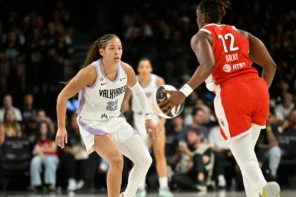

We are roughly a fifth of the way into the 2026 WNBA season. The team that, as of this writing, that has played the most games is the Connecticut Sun. Connecticut has competed in nine games followed by the Toronto Tempo, New York Liberty and Seattle Storm at eight contests apiece.
The 2026 season is also the season that the WNBA has welcomed new media and streaming partners into the fold. A notable one that has returned to coverage is NBC – which was a media partner of the W in its early days.
With 15 teams currently in the WNBA – and that number increasing to 18 by the year 2030 – it can be sometimes hard to keep up with the number of games that are on national television. This is especially the case considering how much the W is emphasizing national television partners as part of its overall growth strategy.
As we speak, WNBA games can currently be seen on ABC, the ESPN family of networks, NBC, NBCSN, Peacock, CBS, Paramount +, Amazon Prime, USA Network, Ion Television, NBA TV and our trusty friend League Pass. TSN is also airing Tempo contests with Francophone coverage on its sister channel RDS.
That can be a lot of channels to keep up with – but it is also emblematic of how much demand there is in 2026 for WNBA basketball.
Remember when we would have to strain just to get a few WNBA games on ESPN? Remember when contests aired on Lifetime? Those days are over.
For all of the criticism we can lob at Cathy Engelbert (and a great deal of it is warranted), we must give Engelbert credit for understanding national television coverage is the way to go. It mirrors the strategy that has worked for eons with the NFL.
Every single NFL game can be aired on a national channel – whether that is CBS, Fox, NBC, ABC, ESPN or, nowadays, a streamer such as Amazon Prime or Netflix. On top of that, the NFL’s signature event – the Super Bowl – also rotates between its broadcast partners.
The agreement the WNBA inked for the Finals is very similar to what the NFL has for distribution of its games. Throughout the duration of the WNBA’s new television and streaming pact, NBC and Peacock will have rights to the Finals this year as well as in 2030 and 2034. Amazon Prime will air the Finals in 2028 and 2032 with ABC/ESPN airing the Finals in odd-numbered years.
The strategy to place emphasis on national coverage is also a shrewd one for another reason. Look at what is happening with the regional sports network landscape. The RSN, outside of the biggest of markets, appears to be going the way of the dodo bird.
It was not that long ago that games for the Minnesota Lynx, Atlanta Dream, Dallas Wings, Indiana Fever and Phoenix Mercury aired locally on RSNs. Those RSNs were under the banners of Fox Sports, Bally Sports and – most recently – FanDuel Sports.
That remains the case for teams such as the Sun who are on NBC Sports Boston, the Los Angeles Sparks whose games air on Spectrum SportsNet and the Washington Mystics whose games air on the Monumental Sports Network (Monumental is the Ted Leonsis-led entity that owns the Mystics).
An advantage of what the WNBA is doing is it is emphasizing coverage on national television and streaming partners while still maintaining local access to games. The Liberty are a perfect example of this as its games can be available in the New York City market on either WNYW-TV Fox 5 or its sister channel WWOR-TV My9. There is the blackout issue that the WNBA and its fans still have to address.
What the NFL did with its television strategy is it allowed for every single one of its teams to build national fanbases. As the WNBA grows, ensuring that every single one of its teams can be both local and national (and international) is smart business. Also, the W is taking advantage of basketball being the most individualized of the major team sports.
Marquee players such as A’ja Wilson, Breanna Stewart, Napheesa Collier, Caitlin Clark, Angel Reese, Paige Bueckers and Flau’jae Johnson will obviously have fans everywhere. But a national television strategy will also do wonders for other rising stars of the W that may be a bit less ballyhooed.
Also, unlike the NFL where its games air predominantly on Sundays, the WNBA can have games airing any day of the week. This means that the W is meeting fan demand its way.
The frustration from fans of it being hard to keep up with where WNBA games are airing is valid. But compared to the hypothetical scenario of games only being available locally or regionally (a problem that sandbagged Major League Baseball for years), this is a good problem to have.
Having the W on a multitude of channels is certainly better than it being only available on one that may not even be prominently featured in a channel lineup. And considering the current bull market surrounding the W, the smart play involves quantity to deliver quality.