
It was obvious prior to the start of this season – and throughout the 2026 campaign – that the Atlanta Dream’s primary arena was no longer sufficient enough to handle the increased demand the team was seeing.
Much of that was because of Angel Reese but a lot of that also had to do with how the team performed throughout the season.
The Dream entered the playoffs as the fourth seed, seemingly facing an uphill climb to the WNBA Finals. This is also a franchise that has not competed in a WNBA Finals since 2013 during the days where the team was led by another Angel (McCoughtry).
Except the Dream managed to sweep both of its playoff series against the Washington Mystics and New York Liberty. Atlanta has yet to lose a game during this postseason and has played its home postseason matchups in the friendly confines of State Farm Arena – the very venue where the Dream is set to relocate to full-time next season.
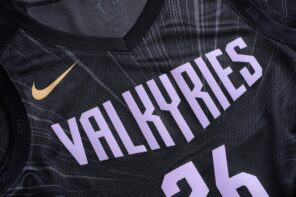
Until that happens, the Dream have one more hurdle to climb before that 2027 season – these Finals and the vaunted defense of the Golden State Valkyries. In addition, State Farm Arena was already booked between regular season contests between the Atlanta Hawks and Houston Rockets and Cleveland Cavaliers as well as a Sombr concert. Fortunately, it was announced recently that Games 3 and 4 of this year’s WNBA Finals will emanate from the 17,000-seated State Farm Arena.
The worst case scenario for the Dream would have been to return to Gateway Center Arena for Games 3, 4 and 6 of the Finals. Gateway Center Arena is located next to Hartsfield Jackson Atlanta International Airport – well outside of the city’s center – in College Park. Reports out of Atlanta indicate the Dream still are searching for a larger venue for these Finals games.
The option that would make the most sense – if State Farm Arena was not available – would have been McCamish Pavilion on the campus of Georgia Tech. It seats significantly less than State Farm Arena – 8,600 – but is certainly more than the 3,500 of Gateway Center Arena. Another option could be the Georgia State Convocation Center which was built in 2022 and seats 8,000. Again – a far distance from the 17,000 that State Farm Arena enjoys but still more (and in a more desirable locale) than College Park.
Then – there is the Gas South Arena. The pro of Gas South is that it seats 13,000 – close to the capacity of State Farm Arena. The con of it is its location – Gwinnett County. Gas South Arena is at least a 30-minute trek from the ATL’s downtown core and anyone who knows Atlanta understands it lacks a significant public transportation network outside of Fulton, DeKalb and Clayton counties.
And, if all else failed, there’s The Arena At Southlake – which also has a capacity of over 8,000. But it is also in Clayton County and well outside of the main urban core of Atlanta. Of course, this is now a moot point.
If things did not work themselves out, both the Hawks and the Atlanta-Fulton County Recreation Authority have to be asked a specific question regarding this. Firstly – would this still be the case if a certain team in Indiana had qualified for the Finals instead of the Valkyries? As much as so many entities have been traditional rules for said team in Indy, one wonders if the entities that run things at State Farm Arena would be more flexible if the Fever were the Dream’s opponent instead of Golden State. For all we know, that would become an NBA/Adam Silver matter.
Regardless, this is something that the entire WNBA – from the teams to the league itself – has to be more cognizant of going forward. The last thing the WNBA needs are any more situations similar to 2018 when the Washington Mystics faced the Seattle Storm in that year’s Finals. Because Capital One Arena was booked, the Mystics had to play its lone home game at George Mason University.
The last thing the WNBA needs are any more scenarios similar to what the Liberty endured in 2018 and 2019 where the team was sequestered to the Westchester County Center in White Plains. There are high school basketball gyms – especially in Indiana – that seat more than that Westchester venue.
The last thing the WNBA needs are situations similar to the late 2010s when the Sparks played playoff games at college gyms because Crypto.com Arena (Staples Center at the time) was unavailable. Oh – and must we forget in 2017 when the Minnesota Lynx played Finals games against those very Sparks at the University of Minnesota’s barn?
With the WNBA continuing to expand in terms of amounts of teams and games, these arena snafus have the potential of becoming more of a pressing issue going forward. This is something that whoever takes over for Cathy Engelbert following this season will have to address. This is especially the case with teams that are not under NBA ownership.
The Hawks are the entity that would have looked the worst in all of this. They deserve their flowers for letting State Farm Arena be the home court for the Dream in these playoffs and for re-opening its doors to the Dream full-time beginning with the 2027 season. But this almost became a case of the Hawks being too far in that Atlanta forest to see the trees.
Firstly – the Sombr concert could be moved to an alternative venue – either indoors or outdoors. That is what happened when Game 2 had a conflict with a Doja Cat concert at Chase Center – it was moved to a contingency date.
As far as the Hawks games are concerned, NBA games get rescheduled regularly. In the case of the Rockets, the Oct. 24 date – also the date of Game 4 – is the first of a home-and-home between the Hawks and Rockets. The second half of that home-and-home takes place the following Monday at Toyota Center. Game 3 was moved up to Wednesday and Game 4 is still slated to take place on Oct. 24 but was moved up to 1 p.m. from its original 3:30 p.m. time slot.
Could the Oct. 29 date for Cavs and Hawks – which would also be the day of Game 6 if necessary – be rescheduled to that following Friday? Only time will tell but considering the situations for Games 3 and 4 were worked out has to instill confidence that something can be ironed out for Game 6 as well – if needed.
This is an issue as well during the early portions of the regular season as well when WNBA games conflict with NBA playoff games at venues where both W and NBA teams play at.
Also, the Hawks would have had to ask themselves if men’s games during the early portions of the regular season getting first dibs at Atlanta’s largest hoops venue over women’s championship contests is a good look in 2026 – especially in a city that is as progressive as the one it plays in and represents.
Meanwhile, the Hawks have established a somewhat dubious reputation for being a middle-of-the-pack NBA franchise. The Hawks usually finish either a few games above or below .500, wind up in the play-in tournament and get eliminated in the first round if they even qualify for the playoffs.
One can guarantee that there are more sports fans throughout Georgia that are more plugged into the Dream being four wins away from its first championship in franchise history than a regular season game involving the Hawks who have no superstars on its team. Also – the last time the Hawks made the NBA Finals was in the 1960s.
Ultimately, there has to be more proactivity on the part of the WNBA and its teams to ensure that the concept of teams playing games in the Finals at smaller venues is a thing of the past. Women’s sports are not going back to the dark ages where they are playing second fiddle to the men.
Women’s sports are here. Women’s sports are thriving. Women’s sports are big business. Women’s sports are good business. Women’s sports are here to stay.